
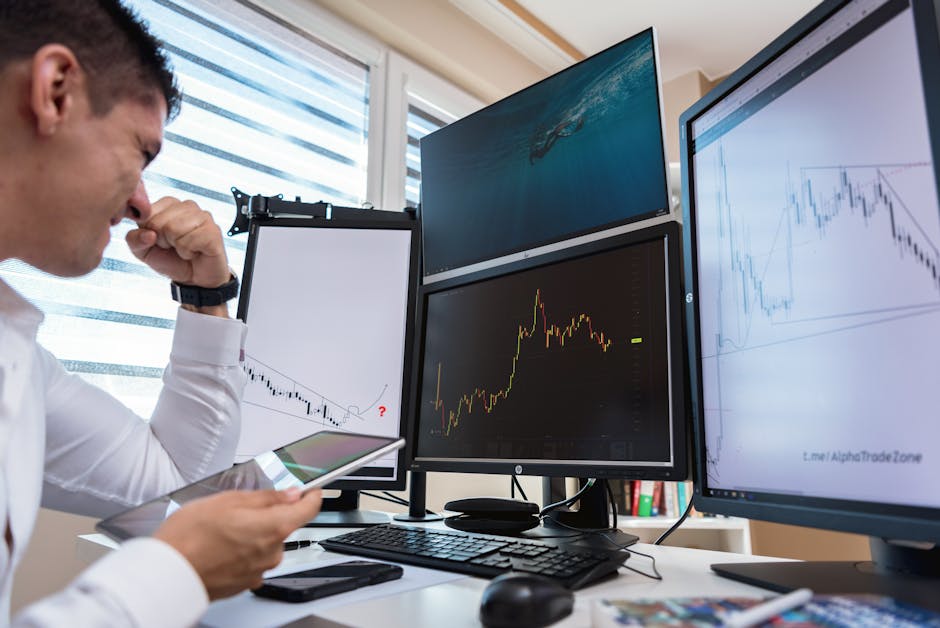
An autonomous bot can increase exposure at the exact moment a trader should be deciding how much risk to carry. When it opens another position during a drawdown, the problem is control: the system has made a portfolio-level decision without asking whether the trader accepts the combined risk.
Consider Daniel, an illustrative composite trader with a $42,000 account and a habit of checking positions between client calls. At 3:47 PM on Friday, he is sitting in a Philadelphia coffee shop, holding a paper cup that has gone cold. His account is down for the week. Two positions remain open, both exposed to the same broad market move.
Then the bot adds a third.
Daniel had configured the strategy months earlier. Each entry satisfied its individual rules. The new trade had a defined stop. On its own, the position looked reasonable.
The account did not.
If the market moved against all three positions before Monday, Daniel could begin the next week with a loss beyond the limit he thought he was following. He had thirteen minutes to inspect the new order, understand the combined exposure, and decide whether to override a system designed to act without him.
For one long minute, he could not remember where the emergency control was.
A valid signal can still create the wrong portfolio
Trading bots usually evaluate conditions defined in advance: price crosses a threshold, volatility reaches a range, or another programmed trigger fires. That can produce a valid signal according to the strategy.
Validity at the signal level says little about whether the trade belongs in the portfolio at that moment.
Daniel already had two positions vulnerable to the same market direction. Adding a third increased concentration, even if each ticker and entry condition differed. Three separate orders can behave like one large bet when the same event pushes all of them together.
This is where position sizing needs context. A trader might cap risk at 1% per trade and assume three trades equal 3% of account risk. Actual exposure can be less tidy. Correlation, gaps, slippage, and changing volatility can make losses cluster. The stop prices provide a plan, not a guarantee of execution at those exact levels.
The useful question at 3:47 PM is broader than “Does this signal meet the rules?” It is: “What happens to the whole account if this idea is wrong at the same time as the others?”
For a deeper look at account-level sizing, see how much should I risk per trade.
The close removes options before it removes risk
Late-Friday entries carry a specific constraint. The decision window is shrinking while uncertainty continues after the regular session ends.
Daniel could close the position immediately, keep it through the weekend, or reduce exposure elsewhere. Every choice had a cost. Closing might mean rejecting a trade that later worked. Holding could leave him exposed to a gap before he had another practical chance to respond. Reducing another position might interfere with a separate strategy.
The bot had no access to the decision Daniel was actually making: how much uncertainty he was willing to carry into Monday.
This is a common weakness in unsupervised automation. The system follows the permissions it was given, including permissions the trader may no longer remember granting. A bad week increases the emotional pressure. The new trade can feel like a chance to recover, which makes a mechanical entry easier to accept without scrutiny.
That is precisely when friction helps. A short pause between signal and execution creates room to inspect total open risk, correlated exposure, entry timing, and the reason for taking the trade. The delay has a cost, since price may move. It also prevents a strategy rule from silently becoming an account-level commitment.
An approval gate puts the exposure decision back with the trader
With six minutes left, Daniel finds the control and closes the new position. He writes down why: existing directional exposure, a weekly loss already near his limit, and no willingness to hold a third related position through the weekend.
The trade might have made money. That does not make the rejection wrong.
A disciplined decision is judged against the information and risk limits available when it was made. Judging only by the later price encourages outcome bias. It teaches traders to celebrate broken rules when the market happens to reward them.
An approval-gated trading assistant changes this sequence. The AI can generate and queue a trade signal, but the trader must approve or reject it before execution. That checkpoint makes the final decision visible. It also gives the trader a concrete moment to ask what the new order does to total exposure.
The gate does not remove losses, uncertainty, or human error. It preserves responsibility. For an example of how repeated approvals and rejections can reveal decision patterns, read 30 days of queued signals: what got approved, what got rejected, and why.
Write the rejection rule before Friday afternoon
On Monday morning, Daniel opens his journal before his chart. The rejected trade moved in his favor after the close. He records that fact, then keeps the original decision unchanged.
His next step is practical. He adds a pre-trade check with four lines:
- Calculate planned loss at the stop.
- Review total open risk if the new position is added.
- Check whether existing positions share the same market exposure.
- Decide whether holding through a closed market fits the plan.
He also writes a hard rule: no automated order may execute without his approval.
At 3:47 PM the following Friday, the account can still be in drawdown. Another signal can still appear. The difference is that added risk waits in a queue until Daniel decides it belongs there.
Educational content, not financial advice.
Comments
No comments yet.