
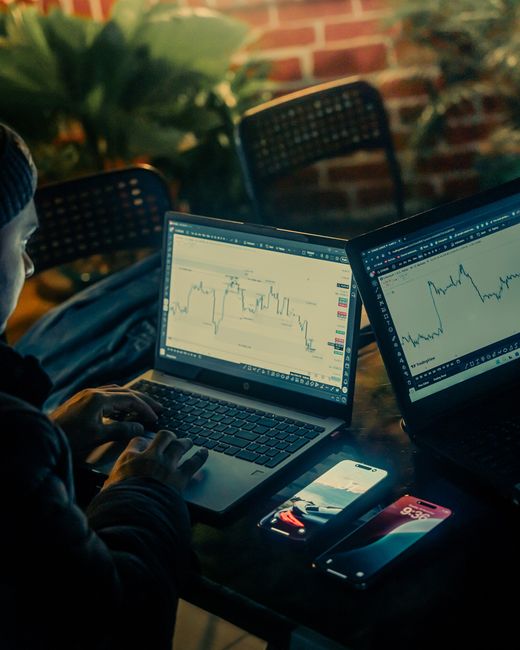
Conviction setups and FOMO spirals can look similar on the chart. The real difference appears in your behavior: how often you refresh, what story you're building to justify entry, whether you can name your thesis without talking around it.
FOMO trades have a physical signature. You refresh the chart every 60 seconds instead of every five minutes. You zoom in to tighter timeframes to find a reason to act now. You open a different pair on another exchange to see if it's "moving the same way." You start with a directional gut feeling and then search backwards through the data to construct a reason it makes sense. By the time you hit the button, you've built a narrative convincing enough to override every rule you wrote when you weren't in the red.
Conviction setups have a different signature. You notice the pattern because it matches something in your journal. You can say exactly why you think it matters. You've already sized the position before you even pulled up the chart. The setup either meets your criteria or it doesn't, and you can walk away without feeling like you've missed something.
The story you tell yourself at 2am
Talia, a software engineer with $45K in trading capital, had written down one rule in her trading journal six months in: "Only take EUR/USD moves when RSI 30-minute crosses above 40 after touching 20 or below." It was specific, testable, and it had worked. She'd built the approval gate into her broker setup to force herself to stop and think before executing.
At 2:15am on a Thursday, she glanced at her phone before sleep. EUR/USD was up 0.8% on news. She opened her chart. The move was real. She felt the pull to act, the kind of breakout she'd caught before. She refreshed. Up 1.1%. She switched to the 5-minute chart. The pattern looked sharp. She refreshed again. Up 1.3%.
Then she pulled up her criteria. RSI was at 38 on the 30-minute. Not 40. Close, but not her rule. She had two choices: send the signal for approval (which she knew she'd rubber-stamp), or close the chart and sleep.
She recognized the tells because she'd taught herself to watch for them. The refreshing. The chart hop to a tighter timeframe where the pattern looked cleaner. The story forming in real time: "RSI is close enough" or "this is different, the news changes things." The feeling that waiting meant missing it. Every one of these is a cognitive flare that says you're chasing narrative, not following a setup.
Talia closed the chart. The EUR/USD move faded over the next two hours. By morning, it had given back most of the gains. She would have been stopped out if she'd chased it.
The checklist that matters when the charts are moving
When a setup catches your attention, ask yourself three things before queuing anything:
Can I name my thesis in one sentence without qualifications? If you have to add "or maybe," "kind of," "I think the market will," then you're building a story, not identifying a setup. Your thesis should exist whether or not you're staring at the chart.
Does this match a pattern I've actually profited from, or am I seeing something I want to see? Pull your journal. If you're not keeping one, here's why you need to start. Does a similar candle pattern, timeframe, or entry condition show up in your winning trades? If this is your first time seeing it, it doesn't deserve your capital at 2am. That's due diligence on your edge, not excitement about a chart.
Did I size this before I looked at the pattern? Position sizing done after you've decided to trade is not position sizing. Here's the math that protects capital. This forces the hard conversations about risk before emotion clouds the math.
Turning the tools against yourself
Approval gates exist to interrupt the momentum that builds in real time. A queued signal you sit with for five minutes often looks different than one you execute in the moment. The delay is the feature, not the friction.
If you find yourself refreshing charts waiting for approval, or explaining away why this setup "actually meets your criteria even though it's close," you've already learned something. Those are diagnostic signs. They're not failures. They're the points where your discipline has a job to do.
The traders who survive long enough to find edges aren't the ones who never chase FOMO. They're the ones who catch themselves doing it and know what to do when they do.
Comments
No comments yet.